Cloud Setup
The software’s cloud segment consists of two primary components:
- Traccar GPS Server
- EMQX MQTT Broker
The embedded software establishes communication via MQTT-SN with the MQTT-SN Gateway within EMQX MQTT broker. Each time a device transmits a message to the MQTT-SN gateway (over MQTT-SN protocol), a predefined rule is activated. This rule extracts pertinent device information like location coordinates, battery percentage, GPS accuracy etc and subsequently relays the message to the Traccar REST server utilizing the HTTP protocol.
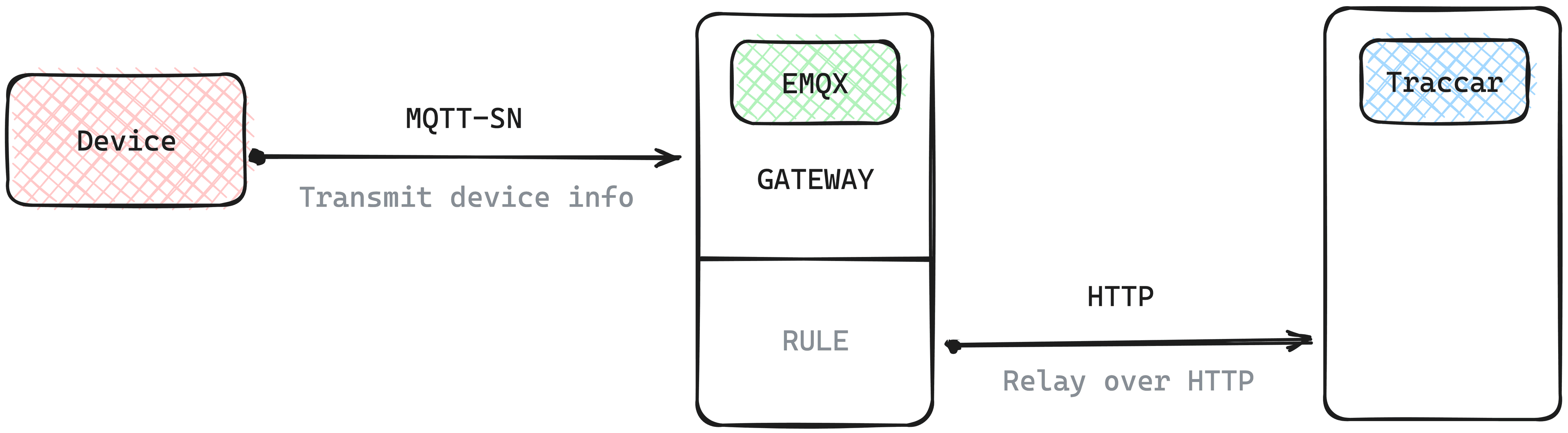
You would run the following commands on the host computer you wish to host the FindMyCat cloud services on. Most people would likely use a Cloud Provider (see Cloud providers) but it is also possible to self host.
Using automated script (recommended)
The cloud repository contains a findmycat.py wrapper around four commands: start, setup, verify and destroy. The script is provided for convinience but if you prefer to install it with Docker or manually, please follow the instruction in the relevant tabs.
Pre-requisites
- Docker Engine Installed (Tested on Docker version 29.7)
- Docker Compose V2 (Tested on v5.4)
- Python 3.8 or newer.
Clone Cloud repository
git clone https://github.com/FindMyCat/cloud.git
cd cloud
Start the stack
Brings up Traccar and EMQX, waits for both containers to come online.
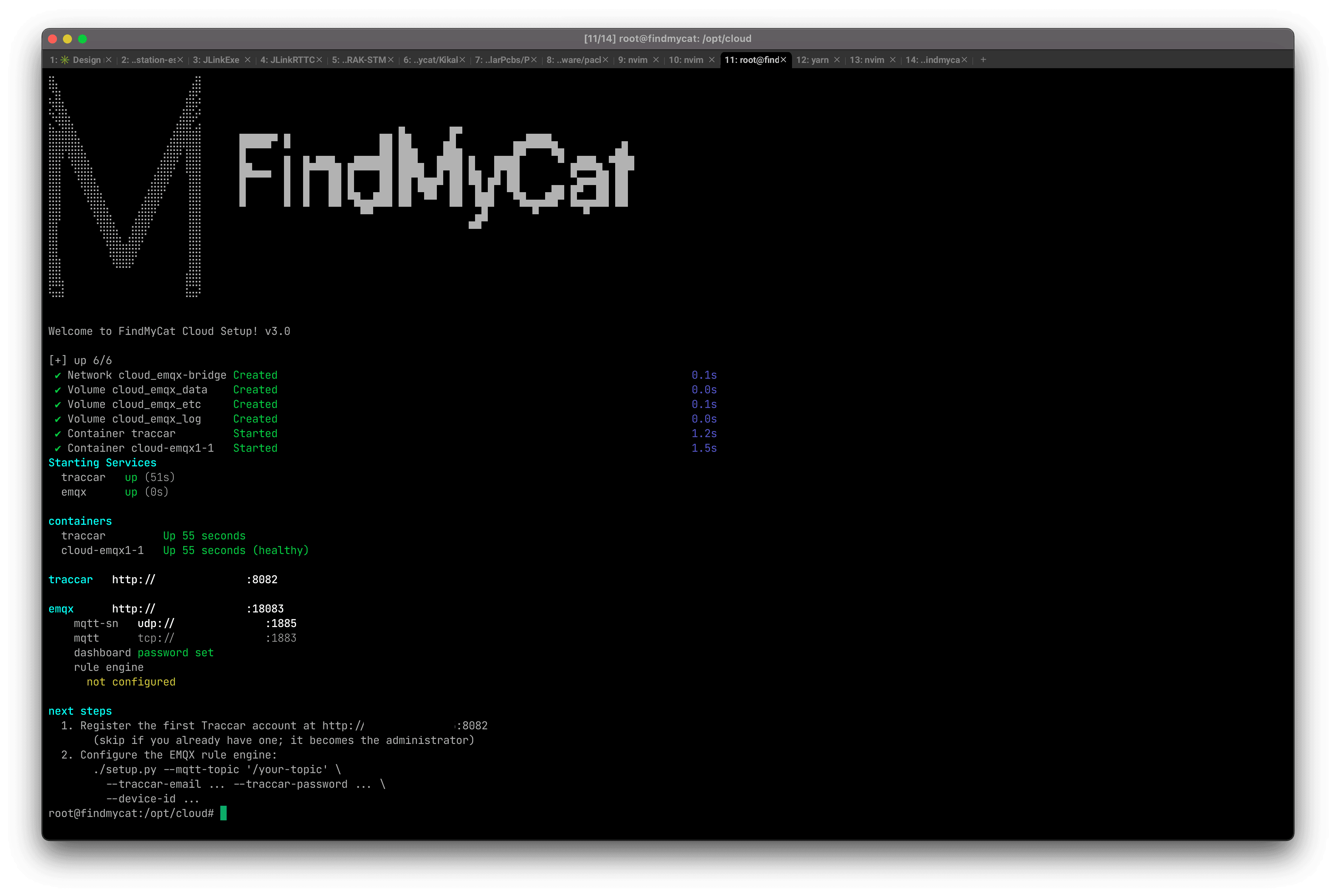
./findmycat.py start --emqx-password 'something-long'--emqx-password replaces the EMQX dashboard’s default admin/public login.
A successful run looks like the following:
Create the Traccar admin account
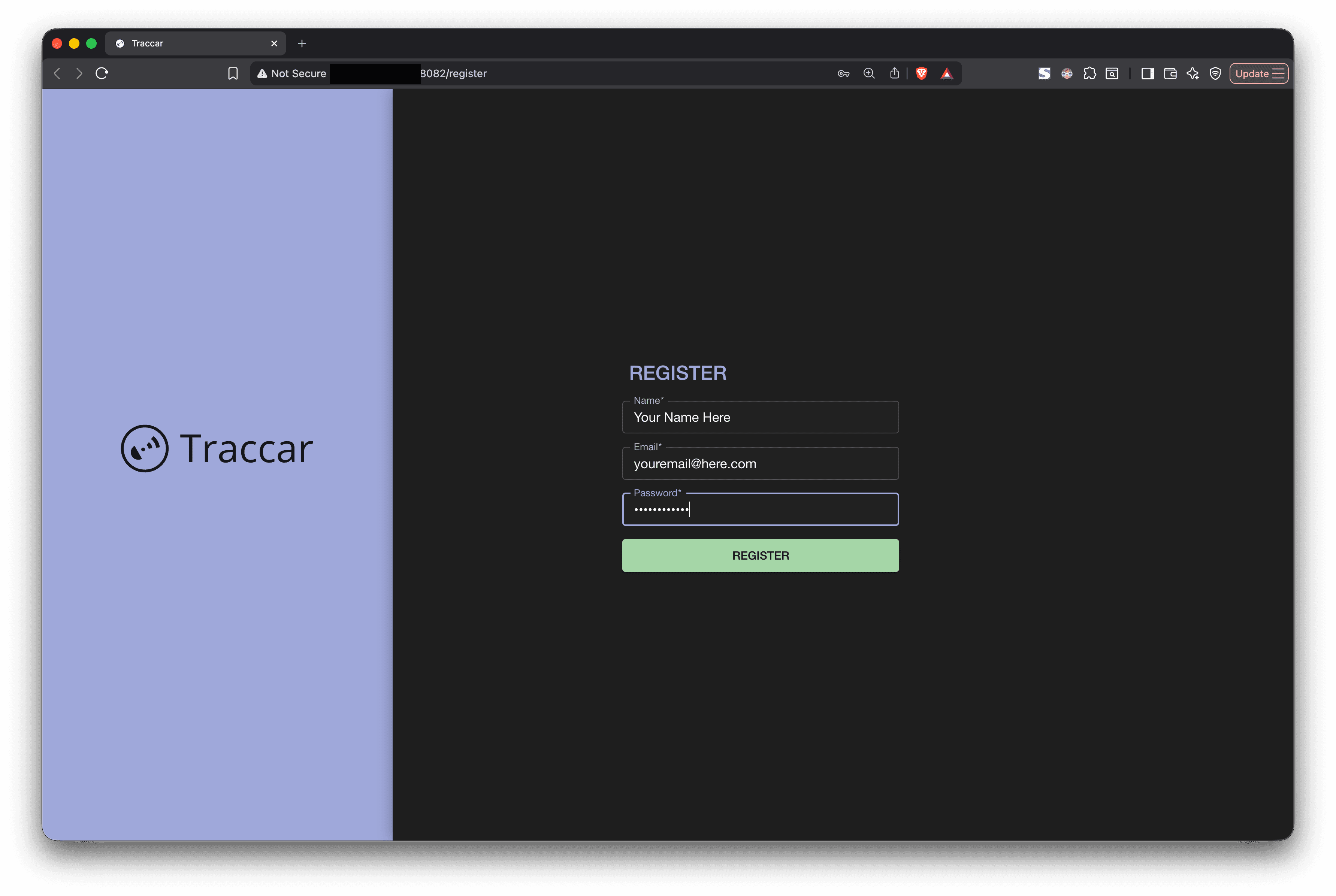
Traccar does not ship with a default administrator account, to create one, open its web UI on port 8082 and register. The script provides a reachable URL for convinience, you can click to open the Traccar UI.
Configure the device and EMQX rule engine
Registers the device id in Traccar, creates the EMQX webhook resource, and creates the rule engine rule. Use Traccar credentials you used to create the admin account in step 3.
./findmycat.py setup \
  --mqtt-topic '/your-chosen-topic-string' \
  --traccar-email you@example.com \
  --traccar-password 'your-password' \
  --device-id your-device-id
Both values have to match the outdoor location engine’s prj.conf:
| Flag | Firmware setting |
|---|---|
--device-id | CONFIG_DEVICE_ID |
--mqtt-topic | CONFIG_MQTT_SN_PUBLISH_TOPIC |
MQTT-SN has no authentication, so pick a topic nobody can guess, such as [}xRDvRP:kN*:8.
Verify it end to end
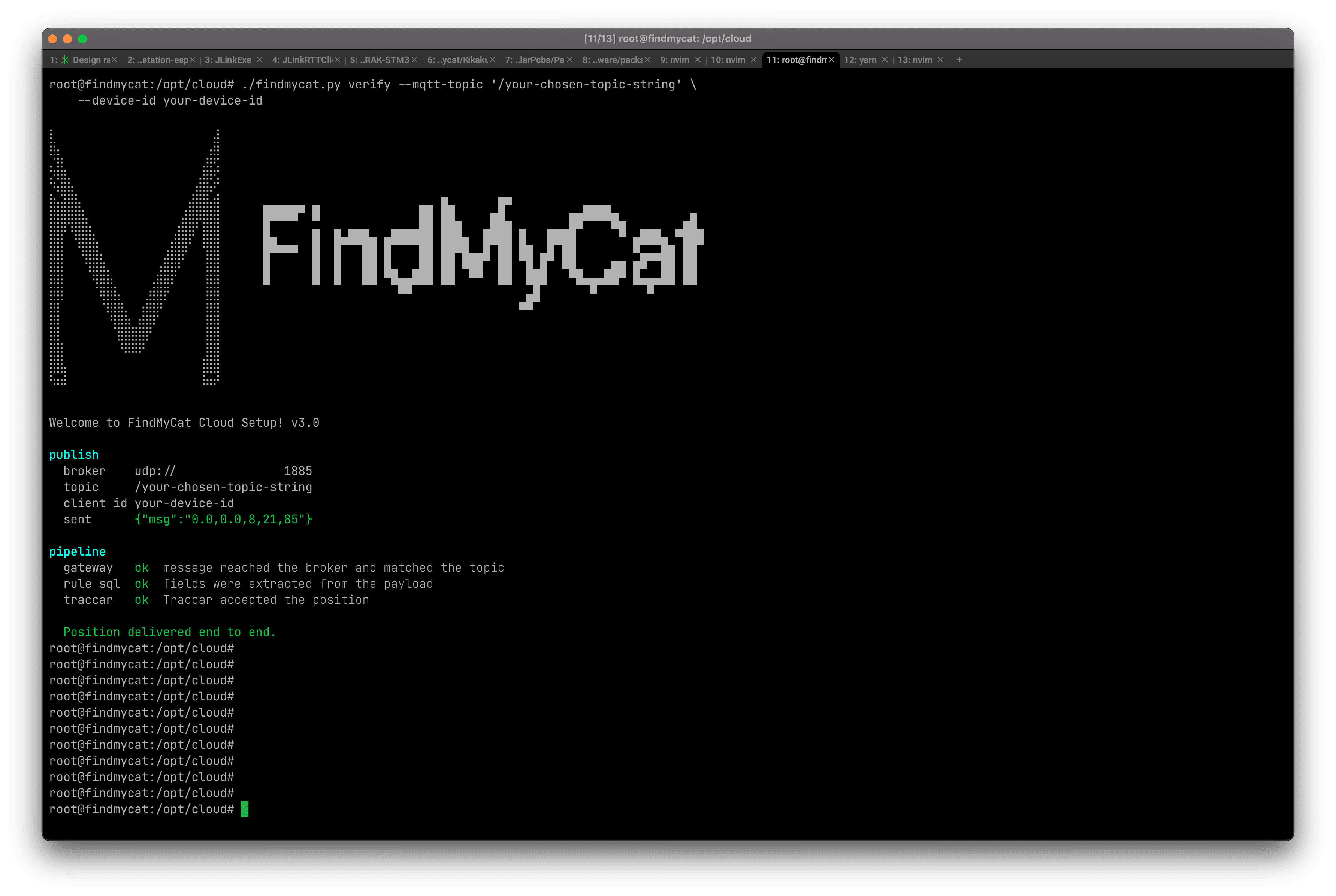
Publishes a test position over MQTT-SN and reports which stage it reached, without needing a real device.
./findmycat.py verify \
  --mqtt-topic '/your-chosen-topic-string' \
--device-id your-device-id| Stage | Meaning |
|---|---|
gateway | The message reached the broker on the right topic |
rule sql | Fields were extracted from the payload |
traccar | Traccar accepted the position |
Run this while the device is disconnected. MQTT-SN allows one live session per client id, so publishing as the device’s id would displace its session.
Succesful run looks like this:
Tearing it down
Stops the containers and removes the EMQX volumes, the Traccar database and its logs. It prints what it
would remove and does nothing unless you pass --yes.
./findmycat.py destroy --yesCloud providers
Any host with Docker works.
DigitalOcean
| Setting | Value |
|---|---|
| Image | Ubuntu 24.04 LTS |
| Size | 512 MB / 1 vCPU |
Add 2 GB of swap. EMQX and Traccar do not both fit in 512 MB without it.
fallocate -l 2G /swapfile && chmod 600 /swapfile && mkswap /swapfile && swapon /swapfile
echo '/swapfile none swap sw 0 0' >> /etc/fstab
Firewall:
| Port | Access |
|---|---|
1885/udp | Public. The tracker connects here. |
8082, 18083, 1883, 5055 | Your IP only |